Fixed quotes, same day response
Set one written standard for every agency driver before they take the keys, with clear induction, checks, reporting and sign-off controls.
Transport managers and compliance specialists • 20+ years practical experience • Fixed written quotes
The most expensive sentence in road transport is: he was only an agency driver.
Clear, practical support written around the operation you run and the evidence an examiner expects to see.
Answer a few focused questions. A transport manager or compliance specialist will review your answers and recommend the right next step.
Get your fixed written quoteThe most expensive sentence in road transport is: he was only an agency driver. When an agency driver is caught over hours, driving a defective vehicle or using a phone at the wheel of your truck, the infringement lands on your operator licence, not the agency's ledger. On agency drivers operator licence holders carry exactly the same responsibility as they do for their own employed drivers, because the work is being done under their authority and their discs.
We have sat through public inquiries where an operator's employed drivers were near spotless and the case was built almost entirely on agency cover: missed downloads, no inductions, no infringement debriefs. The traffic commissioner's question is always the same. What did you do to bring temporary drivers inside your systems? An agency driver handbook is the first exhibit in a good answer.
Traffic commissioners accept that operators use agency drivers. What they do not accept is a two-tier compliance system where employed drivers are trained, monitored and disciplined while temporary drivers drift through unchecked. The published expectation is parity: same induction standard, same monitoring, same consequences.
In practice the failures follow a pattern we see repeatedly in DVSA investigations: nobody downloaded the agency driver's card, nobody checked their licence directly, nobody briefed them on the defect system, and nobody followed up their infringements because they had already moved on. Each gap is small. Together they read as an operator who has outsourced part of the fleet's compliance to a supplier with no stake in the licence. The agency driver handbook exists to close every one of those gaps in writing.
The induction for an agency driver has to work in under an hour, because that is the time you realistically have before a 06:00 start. It should still cover the essentials without shortcuts:
An assessment drive matters for anything unusual: drawbars, moffetts, fridges, double-decks. Ten minutes in the yard tells you more than any agency CV.
Keep the induction checklist to a single page held in the traffic office. Inductions that depend on finding the right folder do not happen on a 05:30 start, and a checklist only becomes evidence once it is signed by both parties and filed the same day.
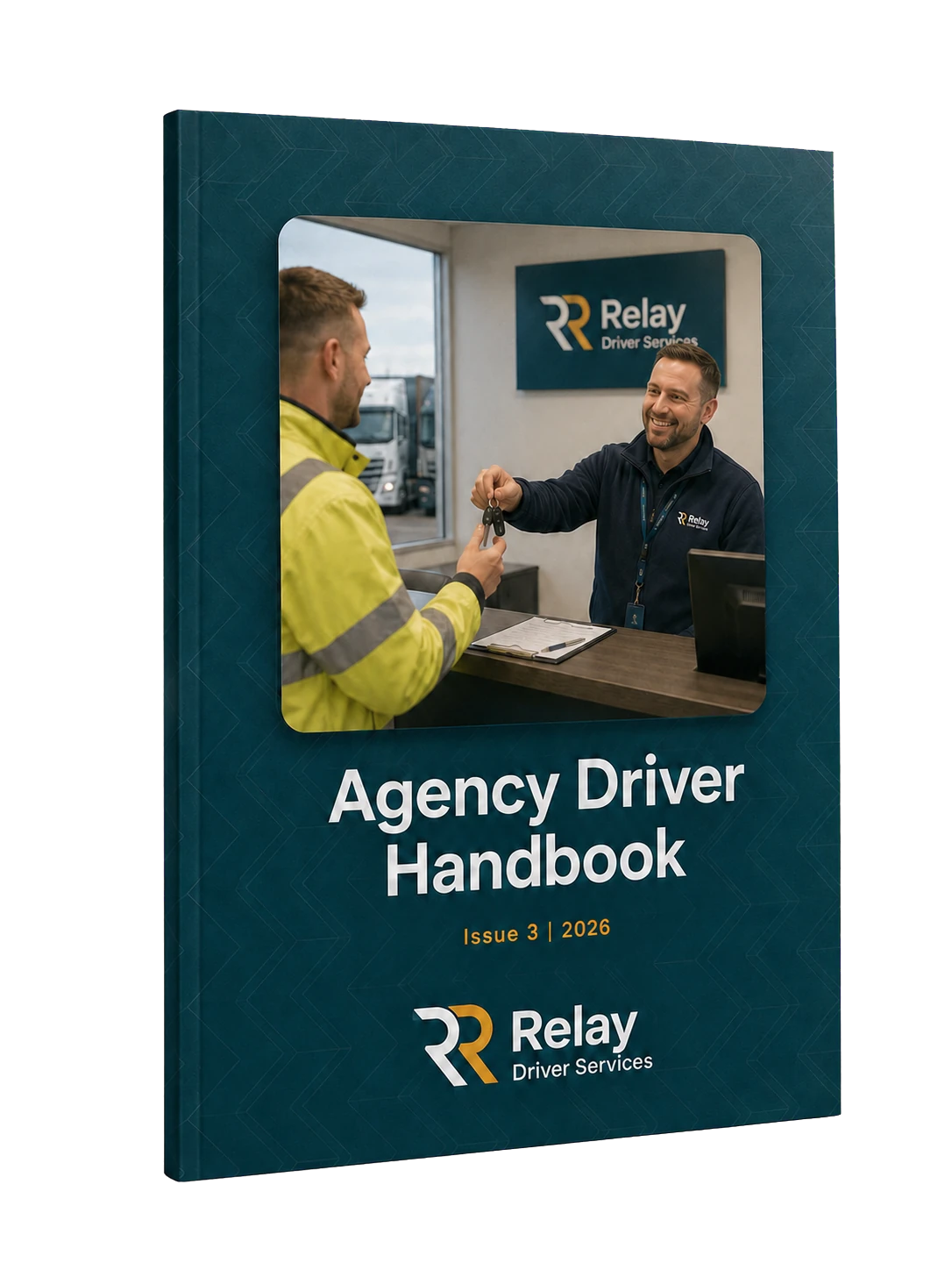
A full employee handbook is the wrong tool for someone who may drive for you three times. The agency driver handbook is a condensed working document, short enough to read at induction and specific enough to be enforced. Ours typically cover: drivers' hours and working time basics with your reporting rules, the walkaround check and written defect reporting, loading and load security expectations, phone and cab technology policy, accident and breakdown procedure, fuel and AdBlue rules, agency-specific points such as who supervises them on site, and the disciplinary route for infringements including your right to refuse a driver back.
Every item should answer a question the driver will actually face on shift. If a section only exists to look thorough, cut it: an agency driver handbook that gets read beats a longer one that gets signed unread.
The handbook works best inside a control pack: one folder, physical or digital, per agency driver. A complete pack holds the licence check result and DVLA check code record, Driver CPC and digicard details, the signed handbook acknowledgement, the induction checklist with the inductor's signature, the assessment drive record where one was done, card download records for every period worked, and any infringement letters with the driver's response.
When DVSA arrives unannounced, the difference between a clean visit and a follow-up investigation is often whether that pack exists. It also disciplines the agencies themselves: suppliers quickly learn which operators check, and they send their better drivers to the sites that do.
Keep the pack alive rather than archived. Card downloads should be added for every period worked, not just the first week, and infringement letters should show a response and a debrief, because a pack that stops updating after the induction reads as a system that was built for show. Digital packs work well provided each document carries a date and a name: when DVSA examines agency arrangements, they test whether the records were created at the time or assembled afterwards, and metadata answers that question whether you want it to or not.
The agencies you use should see your standards before they supply a single shift. Send them the agency driver handbook, your induction checklist and your infringement policy, and make compliance with all three a written term of the booking. Agree how card downloads will happen for drivers who work for several operators in the same week, and keep a simple record of drivers you will not accept back, with reasons.
Operators who do this find the relationship improves rather than sours. The agency knows exactly what gets a driver returned, the drivers know the rules before they arrive, and your transport manager stops discovering problems at the tribunal stage. Temporary labour does not have to mean temporary standards, and on agency drivers operator licence risk is only as big as the system you fail to build.
Every document is shaped by transport managers and compliance specialists with more than 20 years of experience, including DVSA investigations, Public Inquiries and Traffic Commissioner hearings.
Get your fixed written quoteYes. While an agency driver works under your operator licence you must monitor their hours, download their card and act on infringements exactly as you would for an employed driver. The agency's own checks do not discharge your duty.
No. Traffic commissioners expect operators to verify licences, Driver CPC and tachograph cards directly. Keep your own record of every check, including the DVLA check code result and the date.
A condensed agency driver handbook works better: hours, checks, defects, phones, accidents and site rules in a document that can be read and signed at induction. Give the full handbook to agency drivers who become long-term regulars.
Yes, for every period they drive in scope for you. Agree the download method at booking stage, because drivers who serve several operators in one week are the ones whose data most often goes missing.
Follow the same process as for employed drivers: record the infringement, debrief the driver, keep the paperwork and inform the agency in writing. If the conduct is serious, refuse the driver in future and note why. That paper trail is what protects the licence.
Something else on your mind? Call 0208 088 8371 or use the form below.
Get a clear recommendation from transport managers and compliance specialists with more than 20 years of casework, including DVSA investigations, Public Inquiries and Traffic Commissioner hearings.