Multidrop Courier Driver Handbook

Fixed quotes, reply within one working day

Multidrop work is some of the most time-pressured driving in UK transport.

20+Years of experience
100%Fixed written quotes
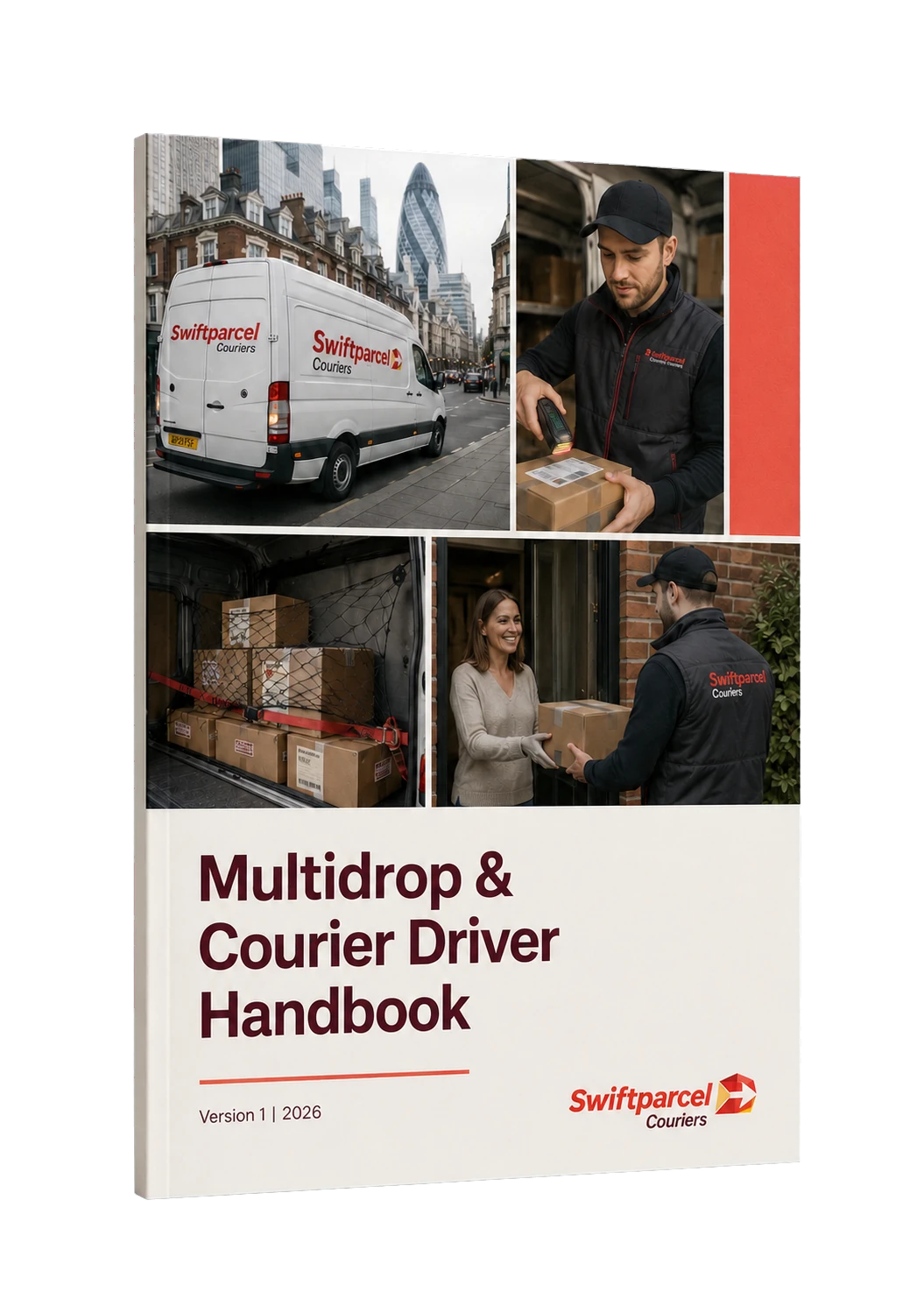
Multidrop and Courier Driver Handbook cover branded for Swiftparcel Couriers
Home/Multidrop Courier Driver Handbook

Multidrop work is some of the most time-pressured driving in UK transport.

Clear, practical support written around the operation you run and the evidence an examiner expects to see.

Start here

Get a specialist recommendation

Answer a few focused questions. A transport manager or compliance specialist will review your answers and recommend the right next step.

Get a quote
Built for the operation you run

Why it matters

A delivery target must never become an instruction to speed, use a phone while driving or leave a vehicle in an unsafe place. The handbook should set priorities that still work when the round is busy.

Clear rules, backed by induction, vehicle records and incident review, help drivers make defensible decisions at the kerbside and give managers a consistent basis for supervision.

Multidrop and Courier Driver Handbook cover branded for Swiftparcel Couriers
Sample cover. Your handbook is written for your operation and supplied in your branding.

What your multidrop and courier driver handbook documents

01

Vehicle checks and defects: a daily van check, damage recording, tyres, lights, doors, load area and the stop-use process.

02

Loading and parcel security: gross weight, payload, load distribution, restraint, high-value goods, keys and unattended vehicles.

03

Route and time planning: realistic rounds, breaks, fatigue, delays and a clear rule that safety takes priority over a delivery window.

04

Phones, scanners and apps: no hand-held use while driving, safe stopping before interaction and limits on hands-free distraction.

05

Parking and kerbside safety: loading restrictions, pavements, cycle lanes, reversing, doors, engines and contact with the public.

06

Manual handling and doorstep work: lifting, trolleys, stairs, animals, refusal of unsafe tasks and failed delivery evidence.

07

Hours and working time: the rules that apply to the vehicle, combination and journey. From 1 July 2026, the assimilated drivers' hours and tachograph rules apply to light goods vehicles or combinations exceeding 2.5 tonnes when used for international transport operations within the UK and EU, unless an exemption applies.

08

Incidents and subcontractors: collisions, damage, complaints, lost parcels and consistent rules for employed and contracted drivers.

Get a fixed-price multidrop and courier handbook written for your operationTell us about your fleet and work. We will reply within one working day, with no obligation.

Final mile pressure needs rules that survive it

Multidrop work is some of the most time-pressured driving in UK transport. A courier can face a round of well over a hundred stops, an app counting down against every one of them, and a customer rating waiting at the end. Under that pressure, any rule that only works in theory gets abandoned by the second week.
That is why a courier driver handbook has to be written from the round, not from a desk. Every instruction in it should have been tested against one question: can a driver actually follow this at drop 87 on a wet Friday in December? Where the honest answer is no, the rule needs rewriting, because a handbook full of ignored rules is worse than no handbook at all when an investigator starts comparing what you wrote with what your drivers do.

Multidrop driver rules that hold up on the round

The multidrop driver rules that matter are the ones that manage risk without pretending the schedule does not exist. The core set we build into every courier driver handbook covers speed and driving style between closely spaced stops, seatbelt use on every movement including the fifty-metre shuffle, securing the vehicle at every drop with the keys out of the ignition, safe reversing with an instruction to avoid it where any alternative exists, and daily route risks such as schools, pedestrian zones and delivery timeslots that tempt drivers to rush.

Each rule should say what the company will do to make it achievable. If you expect a locked van at every stop, fit slam locks. If you expect no reversing on residential streets, plan rounds that allow it. Drivers spot one-sided rulebooks instantly and price them accordingly.

Phones, apps and distraction

Final mile work runs on a handheld device, and that is exactly the problem. The same phone that scans parcels also rings, messages and navigates, and the law does not care which app was open when the vehicle drifted. Using a handheld phone while driving carries six penalty points, which for many young couriers on a licence held less than two years means revocation.

The courier driver handbook must draw the line without ambiguity: the device lives in a cradle or a pocket while the van is moving, all interaction happens while parked and secure, and navigation is set before moving off. Ban the grey zone too, such as scanning the next parcel while rolling between houses. It is the habit most likely to end in a collision the driver never saw coming, and the first thing an investigator will ask about afterwards.

Parking, kerbside and the public

Couriers meet the public at every stop, and most complaints, claims and viral clips start at the kerb. The handbook should give drivers a workable parking hierarchy: legal and safe first, never blocking crossings, junctions, dropped kerbs or emergency access, hazard lights used honestly rather than as a permit, and a clear instruction that a parking ticket is recoverable but a pedestrian struck on a footway is not.

Add doorstep conduct: photographing deliveries respectfully, safe place rules, dogs, gates and gardens, and what to do when a customer becomes aggressive. A driver who walks away from confrontation and reports it is following the handbook; make sure it says so, because drivers otherwise assume the company expects them to stand their ground for a parcel.

Manual handling at the doorstep

Multidrop injuries rarely come from one heavy lift. They come from hundreds of small ones a day, done fast, twisting out of a side door with a parcel in one hand and a scanner in the other. The courier driver handbook should set out load order and van organisation so the next parcel is always accessible, correct technique for the repetitive lifts that actually happen, the weight point at which a driver must use a trolley or ask for help, and honest guidance on heavy or awkward items to upper floors.

Write it for the injuries in your own accident book: backs, shoulders, knees and fingers trapped in tail doors. A courier off with a back injury costs a round its regular driver, and agency cover on an unfamiliar round is where the next problem usually starts.

Van checks on a vehicle that never stops

A multidrop van can cover more mileage in a week than a private car does in months, on stop-start work that eats brakes, tyres and bulbs. The daily walkaround is not bureaucracy on a fleet like this: it is the only thing standing between high mileage and a prohibition. Require a written check before every shift covering tyres, brakes, lights, mirrors, wipers, doors and load area, with photographs where your system supports them.

Defects must be reported in writing before the round starts, and the courier driver handbook must state who decides whether the van goes out. On subcontracted fleets that decision point is often missing entirely, and it shows when a final mile van is pulled in for a check with defects a walkaround would have caught.

Subcontractors, owner-drivers and whose rules apply

Final mile networks run on layers: the retailer, the carrier, the subcontractor, sometimes an owner-driver at the end of the chain. The compliance risk sits wherever the standards run out. If subcontracted drivers deliver under your brand or your contracts, their conduct is your reputational exposure, and how far your legal exposure follows depends on the contract and on how much control you have over the work.

A courier driver handbook should therefore be a condition of the work, not a staff benefit. Issue it to every driver on the contract, employed or not, take signed acknowledgements, and audit against it: ride-outs, telematics review, spot checks on walkarounds and device use. Subcontractors who resist paperwork will also resist maintenance spend, and that tells you what you need to know about them before a traffic commissioner does.

Prefer to talk it through?Call 020 8088 8371
Backed by real transport experience

Documents built for scrutiny, not a shelf

Every document is shaped by transport managers and compliance specialists with more than 20 years of experience, including DVSA investigations, Public Inquiries and Traffic Commissioner hearings.

Get a quote
20+Years of experience
100%Fixed written quotes
Quick answers

Questions operators ask us

Do self-employed couriers need a driver handbook?

In practice, yes. How far your legal duties reach depends on the contract and on how much control you have over the work, but they still deliver under someone's contract and brand, so the standards need to be written down. A signed courier driver handbook is the cleanest way to evidence what they agreed to.

What are the multidrop driver rules on phone use?

The law is the same as for any driver: no handheld device use while driving, with six penalty points for a breach. Because couriers work from a handheld device all day, the handbook must spell out that all scanning, messaging and navigation happens while parked.

Do 3.5 tonne courier vans fall under drivers' hours rules?

Domestic final mile work in vans is generally covered by the GB domestic rules: 10 hours driving and 11 hours duty per day. Towing, or international work in vans over 2.5 tonnes, can bring EU rules and tachographs into scope.

How do we enforce standards on subcontractor fleets?

Make the handbook a contractual condition, take signed acknowledgements from every driver on the contract, and audit with ride-outs and telematics. Standards that are not audited are treated as optional within weeks.

Something else on your mind? Call 020 8088 8371 or use the form below.

Driver Handbooks assessment

Tell us what your operation needs

Get a clear recommendation from transport managers and compliance specialists with more than 20 years of experience, including DVSA investigations, Public Inquiries and Traffic Commissioner hearings.

About 3 minutesNo obligationReply within one working day
1 Need 2 Operation 3 Timing 4 Contact
Step 1 of 4

What would you like help with?

Step 2 of 4

Tell us about the operation

Step 3 of 4

What is driving the work?

Step 4 of 4

Where should we send the recommendation?

Your answers will be reviewed by people with practical transport-management and compliance experience, not scored by an automated document generator.