Legislation and official guidance check: each section checked against current official guidance and the rules that apply to the operation.

Fixed quotes, reply within one working day
A driver handbook review only matters if it stands up under scrutiny.
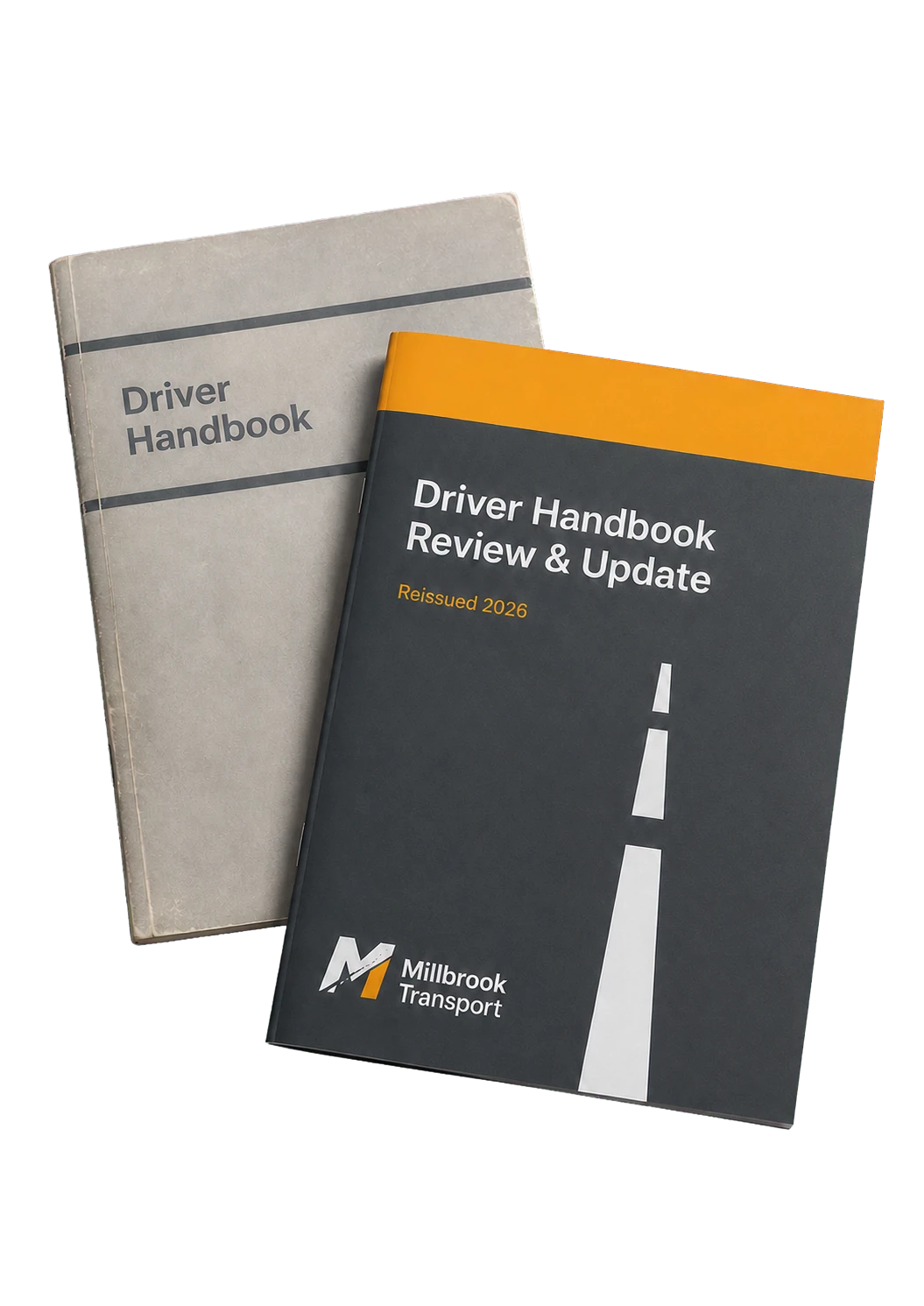
A driver handbook review only matters if it stands up under scrutiny.
Clear, practical support written around the operation you run and the evidence an examiner expects to see.
Answer a few focused questions. A transport manager or compliance specialist will review your answers and recommend the right next step.
Get a quoteA generic driver handbook template can look polished and still be out of date. The useful test is whether it matches the vehicles, people, contracts and control systems in use now.
At a public inquiry or DVSA investigation, a document is not enough by itself. A current handbook, supported by issue records, training evidence and records from the live system, can help show that instructions were clear and management controls were being used.

Legislation and official guidance check: each section checked against current official guidance and the rules that apply to the operation.
Operator licence details: licence type, undertakings, conditions, operating centres and responsibilities checked for accuracy.
Maintenance and defect systems: inspection frequencies, defect reporting, rectification, brake assessment and record retention aligned with the live process.
Drivers' hours and working time: rules, recording methods, analysis, debrief and escalation updated for the work actually undertaken.
Driver controls: licence checks, induction, agency driver arrangements, training, disciplinary links and fitness-to-drive procedures.
Operational changes: new vehicles, depots, contracts, technology, subcontractors and reporting lines reflected in the handbook.
Document control: version number, change log, approval record, issue list and acknowledgement process rebuilt where needed.
Reissue plan: clear actions for briefing drivers, replacing old copies and recording receipt of the new version.

A review is only worth doing if the finished document stands up under scrutiny. When a DVSA examiner or Traffic Commissioner reads it, they are not looking for tidy wording. They are checking whether your instructions match what happens on the ground. Walkround checks, defect reporting, drivers hours and record keeping must line up with the Guide to Maintaining Roadworthiness and your licence undertakings. If the handbook says one thing and drivers do another, that gap is exposed quickly. You get a gap report against current guidance, tracked amendments to the wording, an updated version record and a short list of implementation priorities, so the document reads like a working set of instructions rather than a policy file produced once and left alone.
Outdated material tends to be obvious once you know what to look for. References to VOSA instead of DVSA still appear. Fixed penalty amounts are often wrong or incomplete. Some handbooks still carry COVID contingency sections that serve no purpose now. Direct Vision Standard guidance is another weak point, with many documents still written for pre 2024 requirements and no mention of the Progressive Safe System. Drivers hours sections can also fall behind, missing split breaks, reduced rest options or proper use of digital tachographs. A handbook out of date signals that oversight has slipped.
Each section is tested against current guidance and typical enforcement questions. Daily walkround checks must include nil defect reporting and clear escalation. Defect handling needs defined timescales and responsibility. Drivers hours must cover EU rules, 4.5 hour driving limits, 45 minute breaks, weekly rest and tachograph duties such as manual entries and printouts. Load security, bridge strike prevention and vulnerable road user awareness are checked for clarity. The focus is always the same. Can a driver follow the instruction at 05:00 in the yard without calling the office? If not, the wording is changed.
This is a composite example drawn from common findings rather than one identifiable case. An operator has a handbook that allows defects to be reported by text message. Some drivers send messages, others use paper books, and nil defect reporting is inconsistent. The handbook still refers to VOSA rather than DVSA. Asked which system is actually in force, nobody can give a clear answer. The problem is not the defect itself, it is the absence of a single controlled process. The document does not reflect the operation, and that is what weakens the operator's position at a hearing.
Most operators build their handbook over time, adding sections without removing old ones. That leads to duplication and contradiction. The job here is to bring it back to a single, clear set of instructions. If you operate under FORS Bronze, Silver or Gold, those requirements are set out properly rather than added as an appendix. If there are undertakings following a hearing, they are written into driver duties and management checks. The end result should show a clear line from transport manager control through to driver behaviour, with no ambiguity about who does what and when.
You should always be able to show which version is current. Each issue needs a version number, an issue date and a short amendment record. Drivers confirm that they have received and understood updates, not just the first issue. Old copies are withdrawn so there is no confusion. We have seen depots working from different versions of the same handbook, which creates doubt about every instruction in it. Simple version control removes that risk and shows that changes are issued and applied consistently across the fleet.
Guidance changes, enforcement focus shifts and schemes like DVS evolve, so the handbook needs regular attention. An annual review cycle keeps it aligned without turning it into a major rewrite each time. Drivers hours sections, tachograph guidance, maintenance procedures and vulnerable road user policies should be checked as part of that routine. Any DVSA encounter or audit findings should be fed back into the document straight away. A current handbook reflects recent experience and active management, not something produced only when requested.
Every document is shaped by transport managers and compliance specialists with more than 20 years of experience, including DVSA investigations, Public Inquiries and Traffic Commissioner hearings.
Get a quoteWe start with your operation, vehicles, licence commitments and existing documents, then confirm the work in a fixed written quote.
Yes. We can identify gaps, correct outdated instructions and retain the parts that already work well for your drivers.
Yes. The handbook is shaped around the vehicles, work patterns and controls used in your operation.
Something else on your mind? Call 020 8088 8371 or use the form below.
Get a clear recommendation from transport managers and compliance specialists with more than 20 years of experience, including DVSA investigations, Public Inquiries and Traffic Commissioner hearings.