Low Bridge Signs for HGV Drivers

Official signs with the safe driver response

Know the current travelling height, distinguish a mandatory roundel from a warning triangle and do not continue if the route or available headroom is uncertain.

Home/Visual reference library/Low bridge signs for HGV drivers

A driver-focused guide to mandatory height restrictions, low-bridge warnings and arch-bridge instructions using official Department for Transport artwork.

No sign has been redrawn or generated. The original DfT files are reproduced with Crown copyright and Open Government Licence attribution.

Height, cab notice and route must agree

Check the vehicle, trailer, load and equipment, update the cab notice and raise any route conflict before moving off.

Driver handbook control

Make the escalation route explicit

Your company procedure should state who to call, which details to report and when the vehicle must remain stopped.

Tailored guidanceWritten around your fleet and routesAsk about a handbook

Know the travelling height before the journey starts

Check the maximum height of the vehicle, trailer, load and equipment. The height can change when the trailer, load, fifth-wheel setting or mounted equipment changes. Do not rely on a figure remembered from another combination.

If the overall travelling height is over 3 metres, the correct maximum height must be displayed in the cab where it can easily be read. Check the notice before moving off and update it when the combination changes.
Official low-bridge signs

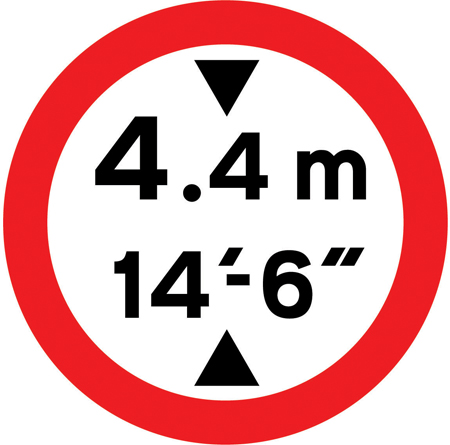
Mandatory circular height restriction sign showing metric and imperial limits
Mandatory height restriction, diagram 629.2A. No vehicle over the height shown may pass.
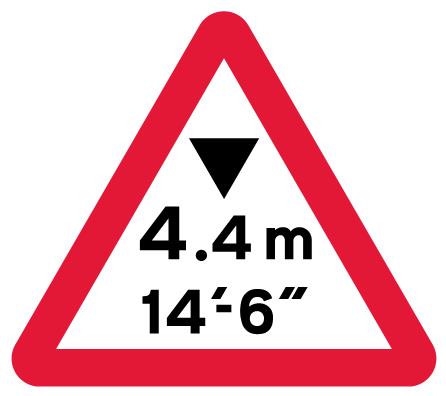
Triangular low bridge warning sign showing metric and imperial headroom
Low-bridge warning, diagram 530A. Maximum headroom at a bridge or overhead obstruction.
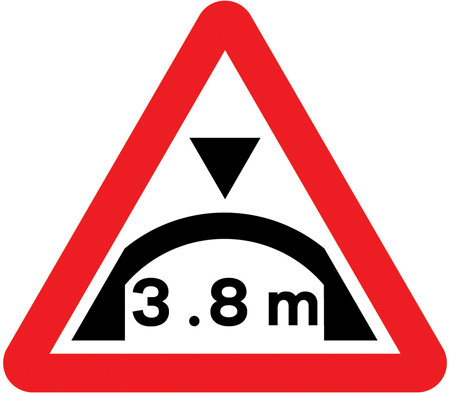
Triangular arch bridge warning sign showing the maximum headroom
Arch-bridge warning, diagram 531.1M. The signed headroom is available through the marked part of the arch.
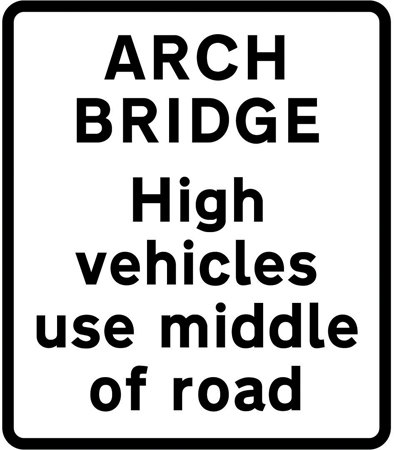
Arch bridge sign instructing high vehicles to use the middle of the road
High vehicles use the middle, diagram 531.2. Follow the road markings and watch for oncoming traffic.

Images are official Department for Transport reproduction artwork. © Crown copyright, reproduced under the Open Government Licence v3.0.

Roundel and triangle are not the same instruction

A red-ring roundel gives an order. It is unlawful for an overheight vehicle to pass a mandatory height restriction. A warning triangle identifies the maximum headroom at the hazard.

At an arch bridge, the greatest clearance is through the marked part of the arch. Vehicle width matters because the signed height is not available across the whole opening.

What to do en route

  • Read the full sign and any distance, direction or diversion plate.
  • Compare the restriction with the current cab-height notice.
  • Do not follow a route because another large vehicle used it.
  • If a high-vehicle warning activates, do not continue towards the bridge.
  • Stop only in a safe and lawful place, then contact the transport office for an alternative route.

If the height or route is uncertain

Do not guess. Tell the transport office your exact location, direction of travel, vehicle and trailer details, displayed height and the complete sign wording. Keep the vehicle away from the restriction until a safe route is confirmed.

Report an incorrect cab notice, unreadable height record or route conflict. The record should be corrected before the vehicle is sent out again.

Official sources

Return to the HGV Driver Signs, Symbols and Codes library.

Low-bridge questions drivers ask

What does a red-ring height sign mean?

It is a mandatory restriction. No vehicle over the height shown may pass the sign.

Is a warning triangle optional?

No. It warns of the maximum headroom at the bridge or obstruction. Compare it with the current travelling height and do not continue if the vehicle may be too high.

Why does width matter at an arch bridge?

The signed headroom is available through the marked part of the arch, not across the whole opening. Follow the road markings and the high-vehicle instruction.

What if the high-vehicle warning activates?

Do not continue towards the bridge. Stop in a safe and lawful place and contact the transport office for a confirmed alternative route.

Need the rule adapted to your routes and vehicles? Use the form below.

Driver Handbooks assessment

Tell us what your operation needs

Get a clear recommendation from transport managers and compliance specialists with more than 20 years of experience, including DVSA investigations, Public Inquiries and Traffic Commissioner hearings.

About 3 minutesNo obligationReply within one working day
1 Need 2 Operation 3 Timing 4 Contact
Step 1 of 4

What would you like help with?

Step 2 of 4

Tell us about the operation

Step 3 of 4

What is driving the work?

Step 4 of 4

Where should we send the recommendation?

Your answers will be reviewed by people with practical transport-management and compliance experience, not scored by an automated document generator.