
Why parcel fleets need their own handbook
Parcel and final mile work runs at a pace the rest of road transport does not see.
Fixed quotes, reply within one working day
Parcel and final mile work runs at a pace the rest of road transport does not see.
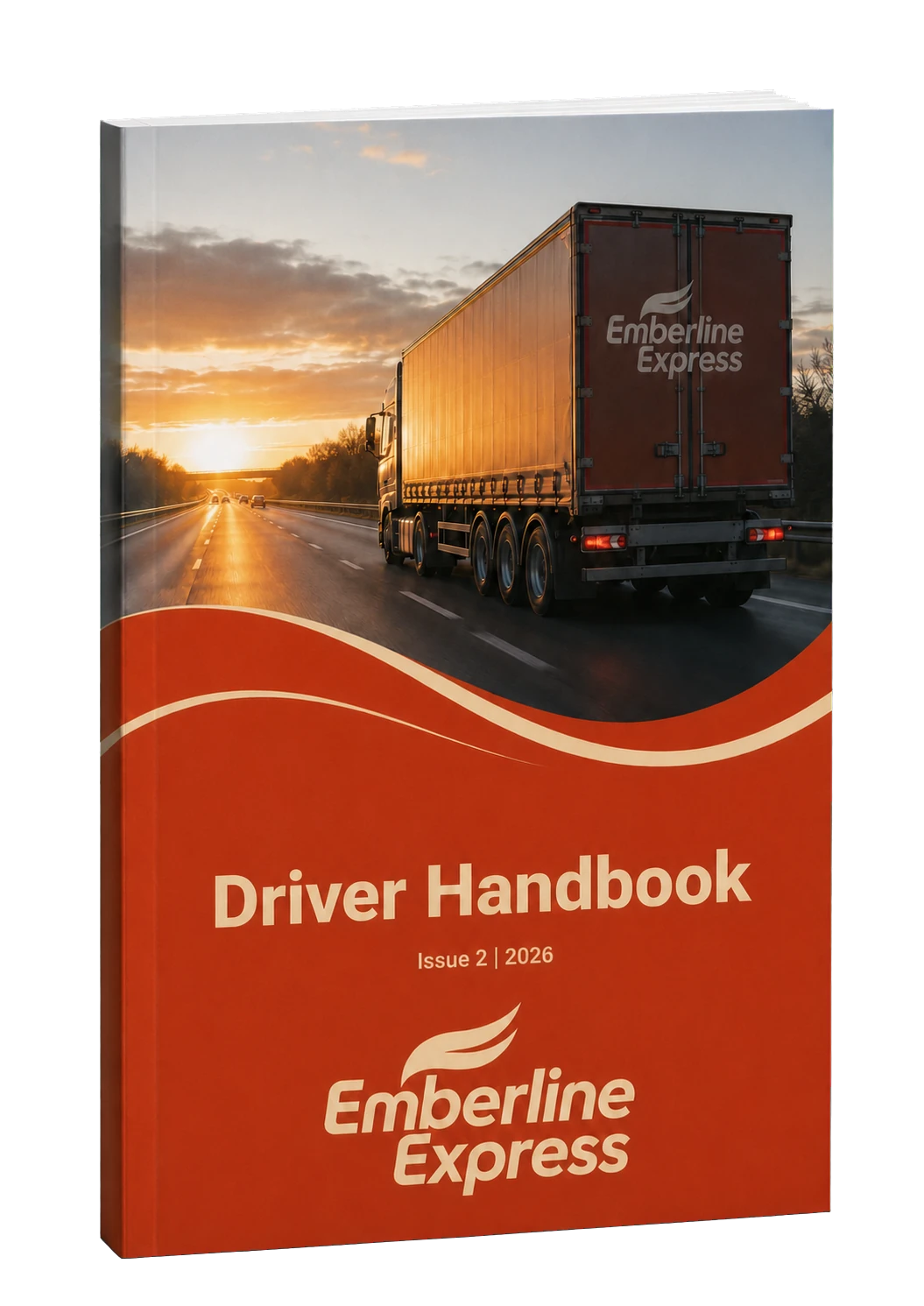
Parcel and final mile work runs at a pace the rest of road transport does not see.
Clear, practical support written around the operation you run and the evidence an examiner expects to see.
Parcel and final mile work runs at a pace the rest of road transport does not see.
Final mile driving is managed through a screen.
Every parcel network flexes for peak.
A depot putting 60 vans out between 06:30 and 07:30 cannot run the same walkaround routine as a fleet of six tractor units, but it still has to run one.

Parcel and final mile work runs at a pace the rest of road transport does not see. Drop counts in the hundreds, routes decided by an app, vans loaded by parcel volume rather than axle weight, and a workforce that can double in the six weeks before Christmas. A generic driving-for-work policy does not survive contact with that. A parcel driver handbook has to be written for the way the job actually happens: phone in cradle, handheld scanner in the other hand, ninety seconds per stop.
We have spent more than 20 years at DVSA roadside checks, in DVSA investigations and at Traffic Commissioner public inquiries, and vans are firmly on the enforcement radar. Overloading, unrestrained load cages, worn tyres and mobile phone offences come up again and again in van stops. When something goes wrong, the first question asked of the operator is simple: what instructions did you give this driver, and can you prove they received them? A well built parcel driver handbook is the answer to both parts of that question.
Final mile driving is managed through a screen. The handbook has to deal with that honestly rather than pretend the phone does not exist. That means clear rules on mounted devices, what a driver may and may not touch while the vehicle is moving, where the van must be parked before a stop is closed out, and what to do when the app sends the driver somewhere a van should not go.
PUDO drops (pick up, drop off points at shops, lockers and forecourts) bring their own hazards: tight service yards, pedestrians and restricted visibility when reversing. So do doorsteps. Safe place decisions, photographing deliveries, dogs, gates, private driveways and customer confrontation all belong in a parcel driver handbook because they are where the incidents actually occur. We write these sections from real claims and real complaints, not from imagination, and we keep the instructions short enough that a driver on stop 84 of 130 can still follow them.
Every parcel network flexes for peak. Agency drivers and seasonal starters arrive in numbers, sometimes inducted on the morning they first drive. Agency staff are often told that last mile driver rules are somehow lighter than the rules for HGV work. They are not lighter, they are different, and the operator still carries the risk while that driver is on its work.
The handbook is the backbone of a defensible same-day induction. We build a short-format version for exactly this situation: the non-negotiables on one spread, a signature and date, and a record that goes straight into the driver file. When an agency driver rolls a van in week one, an operator that can produce a signed handbook acknowledgement can show what that driver was told before it happened. The handbook does not stand on its own, but it is one part of a compliance system that has to hold together. The full parcel driver handbook then follows within the first days of the assignment, with the acknowledgement refreshed.
A depot putting 60 vans out between 06:30 and 07:30 cannot run the same walkaround routine as a fleet of six tractor units, but it still has to run one. The Guide to Maintaining Roadworthiness expects a daily check and written defect reporting from every driver, vans included. The handbook sets out a walkaround that fits the operation: what to check, in what order, how long it should take, and exactly how to report a defect so it reaches someone who can act on it before the vehicle leaves.
Overloading needs its own page. Racking, bulkheads and a full cage load eat payload quickly, and a 3.5 tonne van has far less margin than most loaders assume. Drivers need plain instructions on cage restraint, load spread and what to do when the van feels heavy, because they are the last line of defence at the weighbridge and at the roadside.
Most final mile networks rest on layers of subcontractors and owner drivers, and enforcement does not stop at the first layer. If your brand is on the parcel, your standards need to reach the driver who carries it. We help operators issue a parcel driver handbook to subcontractor drivers as a condition of working the contract, with an issue log and signed acceptance held centrally.
That does two jobs at once. It puts consistent rules in front of every driver on the network, whoever employs them, and it gives the principal operator documented due diligence: evidence that standards were set, communicated and acknowledged. In our experience of DVSA investigations into parcel operations, the subcontractor file is one of the first things examined, and it is usually the thinnest. It does not have to be.
Every handbook we produce is written for the specific operation, but a parcel driver handbook typically covers:
Each handbook carries a version control sheet and a signed acknowledgement page, so you can show at any point who was issued which version and when. That record is what turns a booklet into evidence. If your current parcel driver handbook is a generic template with the logo swapped, it will not do that job, and we would rather tell you that now than have a Traffic Commissioner tell you later.
Every document is shaped by transport managers and compliance specialists with more than 20 years of experience, including DVSA investigations, Public Inquiries and Traffic Commissioner hearings.
Get a quoteYes. Vans below 3.5 tonnes sit outside operator licensing in Great Britain for domestic work, but the duties around roadworthiness, driver behaviour and road risk still apply in full, and DVSA stops vans every day. A handbook is the practical way to show you set standards and communicated them.
Van drivers on domestic work fall under the GB domestic rules and working time requirements rather than the tachograph regime. Vans over 2.5 tonnes used for international hire and reward work need a standard international operator licence, and from 1 July 2026 a smart tachograph must be fitted for those journeys. The handbook states which rules apply to your drivers in plain English.
We build a short-format induction version of the handbook for same-day starts, with a signed acknowledgement that goes into the driver file, followed by the full handbook early in the assignment. It is designed to be workable at peak, not just in January.
Yes, and they should be. We set the handbook up so it can be issued across subcontractors and owner drivers with a central issue log, giving the principal operator documented due diligence for the whole network.
Review it at least annually and whenever the operation changes: new routing app, new vehicle type, new depot processes or a change in the law. Every handbook we supply has a version control sheet so re-issues are tracked and old copies are withdrawn.
Something else on your mind? Call 020 8088 8371 or use the form below.
Get a clear recommendation from transport managers and compliance specialists with more than 20 years of experience, including DVSA investigations, Public Inquiries and Traffic Commissioner hearings.