Handbook specialists

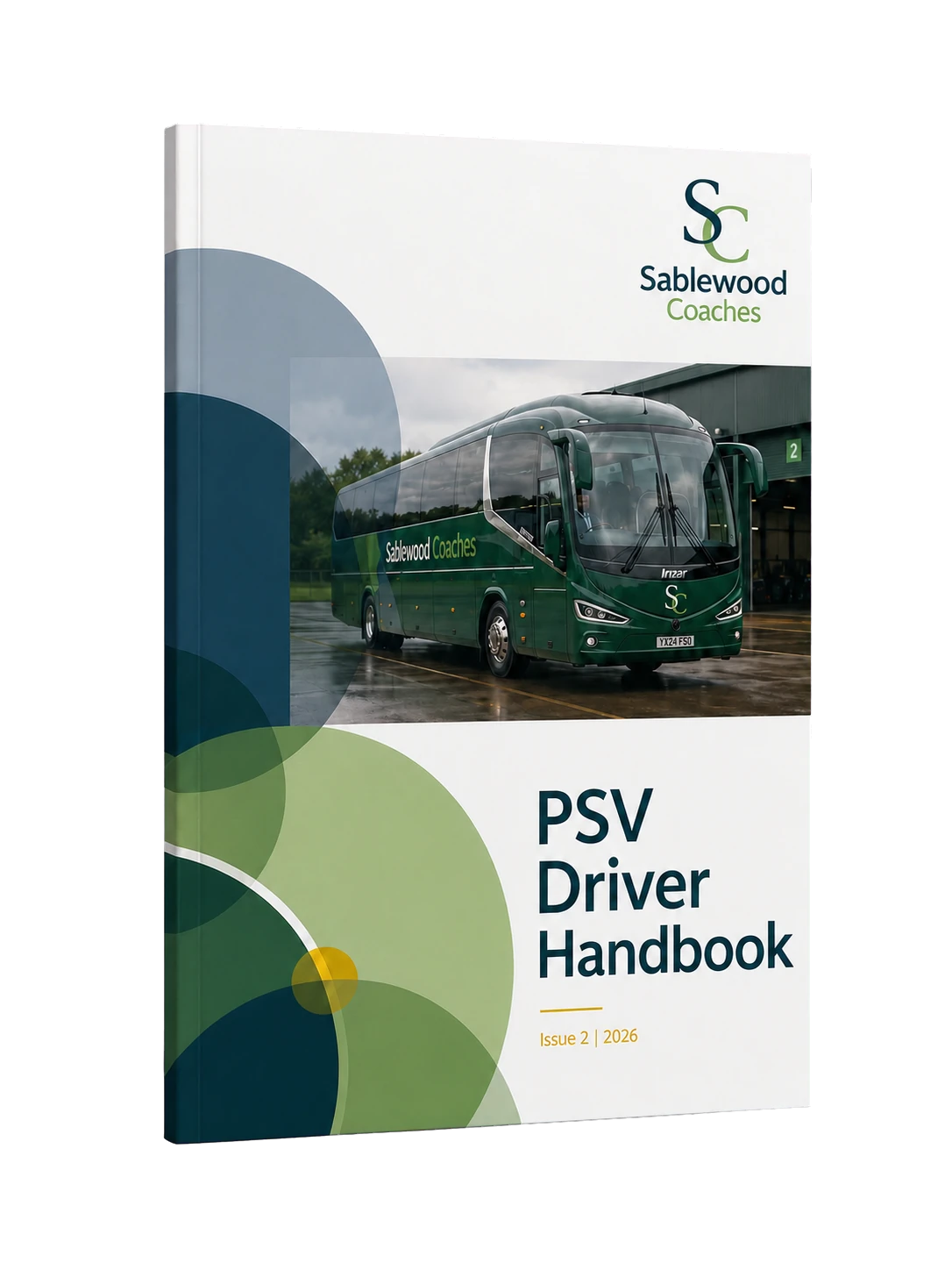
PSV Driver Handbook

Fixed quotes, same day response

A passenger-focused handbook written around your services, vehicles, accessibility duties, safeguarding, checks and professional driver conduct.
Transport managers and compliance specialists 20+ years practical experience Fixed written quotes

20+Years of casework
100%Fixed written quotes
Home/PSV Driver Handbook

A lorry carries goods that cannot complain.

Clear, practical support written around the operation you run and the evidence an examiner expects to see.

Start here

Get a specialist recommendation

Answer a few focused questions. A transport manager or compliance specialist will review your answers and recommend the right next step.

Get your fixed written quote

What makes a PSV driver handbook different

A lorry carries goods that cannot complain. A bus or coach carries people who can, and who can be hurt in ways no insurance policy repairs. That single fact changes what a PSV driver handbook has to do. It is not just a rulebook for the vehicle: it is a rulebook for how your drivers treat the travelling public, from the first stop of the morning to the last drop of a school contract.

Traffic commissioners hold PSV operators to a visibly higher standard, and in the public inquiries we have supported, driver conduct towards passengers appears in the evidence bundle almost as often as maintenance records. A coach driver handbook or bus driver handbook that only covers walkaround checks and fuel cards has missed the point of the licence it sits under.

Passenger safety from first stop to last

The passenger safety section is the heart of any PSV driver handbook. It should cover boarding and alighting, moving off only when passengers are seated or holding on, managing standing passengers where they are permitted, luggage stowage, and pushchairs and mobility aids in the correct spaces.

It also needs the procedures nobody wants to use: evacuation, fire, breakdown on a live carriageway with a full saloon, and what the driver says and does while waiting for help. Drivers who have read a clear procedure act faster and calmer than drivers improvising in front of forty passengers. Write the procedures in plain steps, in the order a driver would actually take them, and keep each one to a single page.

Accessibility duties drivers must get right

Accessibility is a legal duty, not customer service polish. The handbook should set out what the Public Service Vehicles Accessibility Regulations mean in daily practice: deploying ramps and lifts on request, keeping the wheelchair space available and asking other passengers to make way for a wheelchair user, kneeling the vehicle where fitted, and giving passengers time to reach a seat before moving off.

Drivers should know that refusing a wheelchair user because the space is occupied by a pushchair is exactly the situation the courts have examined, and that the operator expects them to make genuine efforts to free the space. Disability awareness sits inside Driver CPC periodic training, and the handbook should carry the same message so that training and daily instruction never contradict each other.

Drivers' hours on PSV work

Few subjects confuse PSV drivers more than which hours rules apply, because the answer changes with the work. Regular services on routes of 50 kilometres or less generally fall under the GB domestic rules, while coaches, tours, private hire and longer routes fall under the EU rules with tachographs, the 4.5 hour driving limit before a break, and daily and weekly rest requirements.

Many drivers switch between the two regimes in a single week. The PSV driver handbook must say which rules apply to which duties, how mixed driving is handled, and what records each regime demands. At DVSA investigations into PSV operators, hours and records are usually the first drawer opened, and a driver who cannot say which rules they were working under is a poor witness for the operator.

Driver CPC and professional conduct

Every professional PSV driver needs a Driver Qualification Card backed by 35 hours of periodic training in each five year cycle, and the handbook should say plainly that driving without a valid card is an offence for the driver and a licensing problem for the operator.

Conduct deserves equal space. The Conduct of Drivers, Inspectors, Conductors and Passengers Regulations still underpin how a PSV driver must behave, and the handbook should translate them into modern expectations: no mobile phone use, professional handling of fares and disputes, no smoking or vaping in the vehicle, and courtesy under provocation. A bus driver is the most visible employee the company has, and every complaint that reaches the traffic commissioner starts as a moment on board.

Track card expiry centrally as well. The PSV driver handbook can require drivers to report renewal training bookings, but the operator must still monitor the dates, because an expired card discovered at the roadside means a driver off the run that morning and an awkward letter to the traffic area office afterwards.

Defect reporting on a vehicle that carries people

PSV walkaround checks go beyond the mechanical. Alongside brakes, tyres, lights and steering, the driver checks the saloon: emergency exits and their signage, hammers in place, doors and sensitive edges working, bell pushes, heating, wheelchair ramps or lifts cycling correctly, and CCTV where fitted. A seat with a protruding fixing or a ramp that jams is a passenger injury waiting for a claim.

The PSV driver handbook should require a written record of every check, nil defects included, and give drivers an unambiguous instruction: if a defect affects safety, the vehicle does not enter service until someone with authority has made that call in writing. Drivers stop reporting defects the first time a report is ignored, so the handbook should also commit the company to answering every report.

School contracts and vulnerable passengers

School and SEND transport brings duties that a standard coach driver handbook never mentions. Drivers and passenger assistants need enhanced DBS checks where the work is regulated activity, safeguarding rules must be explicit (no personal contact with pupils, no photographs, no private arrangements with parents), and the handbook should set out seat belt requirements on dedicated school services and how belts are checked.

Add the practical detail that keeps contracts safe: approved boarding points, never leaving a child alone at a stop, end-of-route sweeps of the saloon so no child is left on board, and exactly who to phone at the school and the council when something goes wrong. Local authorities audit these contracts, and a PSV driver handbook with a strong schools section is regularly the difference between keeping and losing the work.

Prefer to talk it through?Call 0208 088 8371
Backed by real transport experience

Documents built for scrutiny, not a shelf

Every document is shaped by transport managers and compliance specialists with more than 20 years of experience, including DVSA investigations, Public Inquiries and Traffic Commissioner hearings.

Get your fixed written quote
20+Years of casework
100%Fixed written quotes
Quick answers

Questions operators ask us

Is a PSV driver handbook a legal requirement?

No statute names one, but operators must give drivers adequate instruction, and traffic commissioners expect documented systems. A signed handbook is the accepted evidence that instruction actually happened.

Do bus drivers follow EU or GB domestic drivers' hours rules?

It depends on the service. Regular services on routes of 50 kilometres or less generally fall under GB domestic rules. Coaches, tours and longer routes fall under the EU rules with tachographs. Many drivers work under both in the same week, so the handbook must cover mixed driving.

Should coach and bus drivers have separate handbooks?

Usually one document with clearly marked sections works best. The core (conduct, checks, defects, hours) is shared, while coach touring, local service and school contract duties each get their own section.

What accessibility duties should the handbook cover?

Ramp and lift deployment, priority for the wheelchair space, kneeling the vehicle, allowing passengers to reach a seat before moving off, and assistance for passengers with reduced mobility. These reflect legal duties, not optional service standards.

What extra checks apply to school transport drivers?

Enhanced DBS checks where required, safeguarding rules in writing, seat belt checks on dedicated services, approved boarding points and an end-of-route sweep of the vehicle. Councils audit against these points when they review contracts.

Something else on your mind? Call 0208 088 8371 or use the form below.

Driver Handbooks assessment

Tell us what your operation needs

Get a clear recommendation from transport managers and compliance specialists with more than 20 years of casework, including DVSA investigations, Public Inquiries and Traffic Commissioner hearings.

About 3 minutesNo obligationSame-day response
1 Need 2 Operation 3 Timing 4 Contact
Step 1 of 4

What would you like help with?

Step 2 of 4

Tell us about the operation

Step 3 of 4

What is driving the work?

Step 4 of 4

Where should we send the recommendation?

Your answers will be reviewed by people with practical transport-management and compliance experience, not scored by an automated document generator.